
Rising carbon dioxide in the atmosphere is among the defining problems of our time, and any chemical fix has to work at staggering scale: the world emits tens of billions of tons of CO₂ every year. The standard playbook is to react CO₂ with "grabber" molecules that latch onto it, ferry it away, and then release it so the grabber can return for more, much like a claw pulling litter from a stream and dropping it into a bag, over and over. The hard part is rarely the grabbing; instead, it's the letting go, which usually demands a lot of energy.
The most widely used CO2 "grabbers" are amines, and they have a frustrating split personality: they grab CO2 readily but release it only reluctantly. The conventional fix is to dissolve them in water, which raises how much they can hold but exacts a steep energy penalty when it comes time to let go.
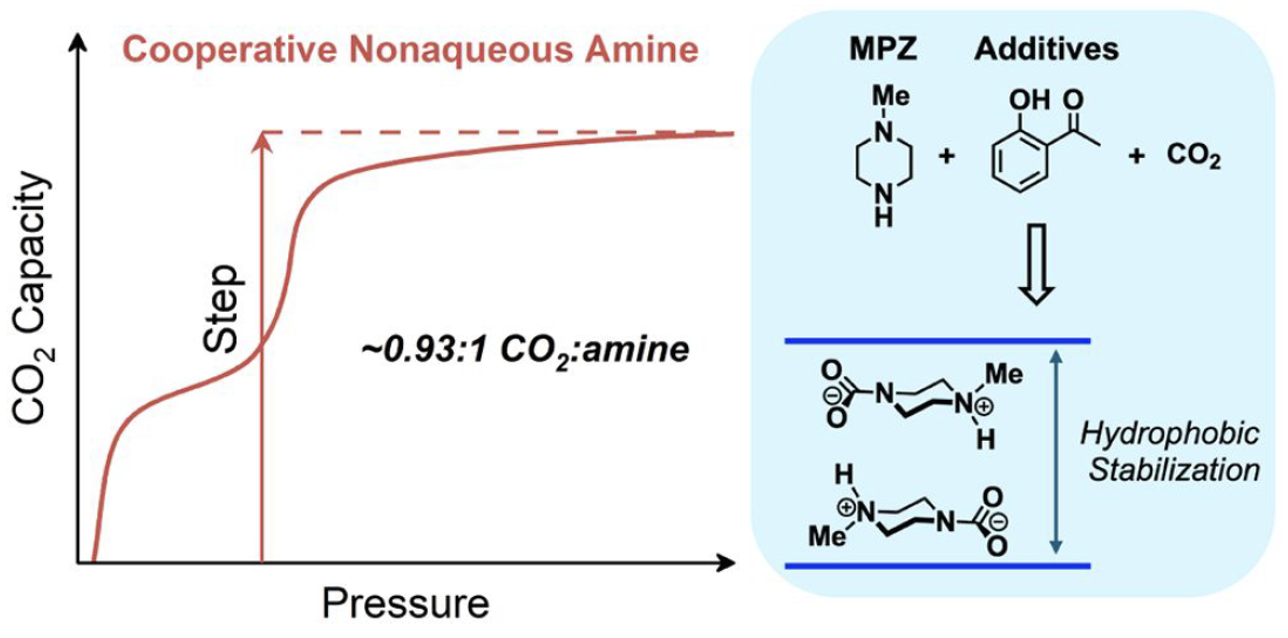
The Georgia Tech team wasn't trying to solve that “letting go” problem at all. Working on a different class of CO2-capture materials, the researchers ran a routine control experiment using an amine simply dissolved in a solvent. They omitted all of the other elaborate molecular machinery they were studying, anticipating no functional activity. Instead, they saw the mixture take up and release CO2 in a way no one expected. That accident became the discovery reported this week in the Journal of the American Chemical Society. Graduate student Lu Lu and colleagues in the laboratories of Ryan Lively (Chemical and Biomolecular Engineering) and M.G. Finn (Chemistry and Biochemistry) describe the use of a particular amine mixed with an unusual solvent, but not water, to create a system that both captures and releases carbon dioxide in efficient fashion.
In their new work, sponsored by Johnson Matthey, the solvent takes the functional place of water by providing extra stabilization to the combined amine-CO2 molecule, making carbon capture much more efficient. But the solvent does this in a very different way than water, which allows for easier release of CO2 with a relatively gentle increase in temperature. The result is a system that should require much less energy to remove carbon dioxide from the exhaust gases of power plants and other industries that burn fossil fuels.
A reminder that even a control experiment can surprise you, and that sometimes leaving something out, water in this case, makes all the difference.
Learn more about this work in a recently published article in the Journal of the American Chemical Society.