
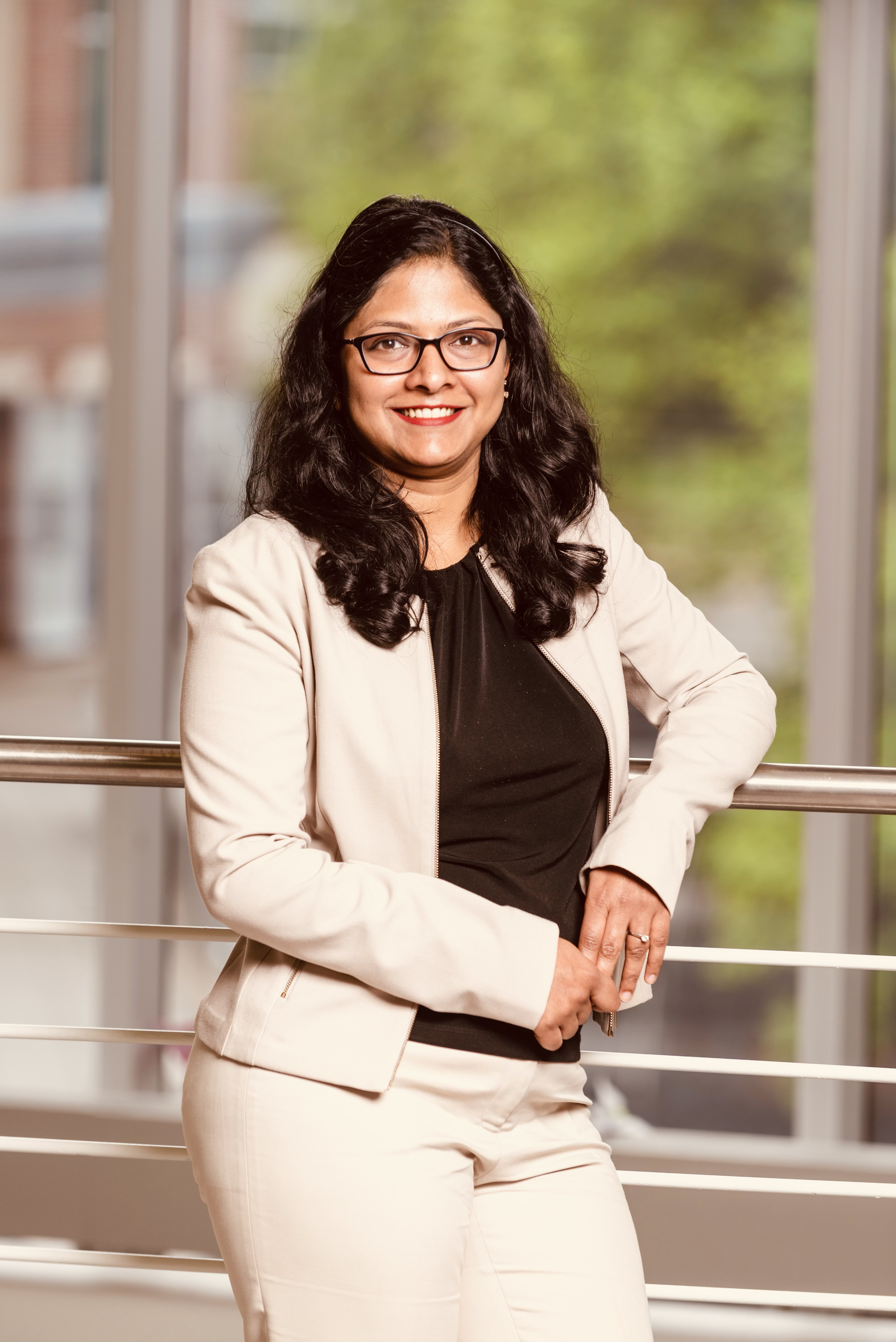
Garg’s groundbreaking research on chemical communication between humans and microbes — and her dedication to advancing women in STEM — has earned her national recognition as a WCC Rising Star.
Associate Professor Neha Garg, Blanchard Early Career Professor in the School of Chemistry and Biochemistry, has been selected as a recipient of the American Chemical Society’s (ACS) 2026 Women Chemists Committee (WCC) Rising Star Award. This national honor recognizes exceptional early- to mid-career women chemists who have demonstrated outstanding promise for contributions to their respective fields.
“The School of Chemistry and Biochemistry is thrilled to see that Neha Garg is included in the current WCC Rising Star cohort,” says School of Chemistry and Biochemistry Chair and Professor Vicki Wysocki. “She is richly deserving of this award, given her excellent work on the interactions between eukaryotes (e.g., humans) and the microbiome.”
Garg obtained her Ph.D. from the University of Illinois Urbana-Champaign and conducted postdoctoral research at UC San Diego (UCSD)'s Skaggs School of Pharmacy and Pharmaceutical Sciences. She has been at Georgia Tech since 2017.
“This award is a tremendous source of personal pride as it acknowledges my lab’s hard work in the field of microbial chemistry,” says Garg. “It’s especially meaningful that it's a WCC award because it serves as a powerful platform for me to inspire young women.”
She adds that visibility remains essential for advancing women in STEM.
“Imposter syndrome is real, so awards like this are important for women in science,” explains Garg. “I’m grateful this recognition exists, and I’m proud and happy to be honored.”
As part of the Rising Star Award, Garg will be honored at a WCC luncheon and deliver a scientific talk highlighting her career path and current research at the ACS Spring 2026 Meeting in March.
Chemical communication and connection
Garg’s lab studies the chemistry that underlies crosstalk between the human microbiome and its host. The microbiome includes vast communities of bacteria living on and inside the body — from the skin and mouth to the gut, reproductive system, and lungs. Her group examines how these microbes and human tissues exchange information through small molecules.
“Our work aims to understand the chemistry of collaboration between the microbiome and its host,” says Garg. “We focus on the lungs and airways, studying how epithelial cells and microbial communities interact through nutrients and microbial compounds. These molecules form a chemical dialogue, and my lab builds models to decode and investigate it.”
By mapping this communication network, Garg hopes to shape future therapeutic strategies.
“Understanding collaboration between the microbiome and the host will help develop microbiome-targeted therapies,” she explains. “These therapeutics could prevent respiratory infections, promote the growth of beneficial bacteria, limit harmful bacteria, or influence host tissues in ways that improve health.”
Her work also extends to marine systems. Garg’s team studies similar chemical interactions between microbes and corals, offering insight into ecosystem resilience and ocean health.
Garg was co-nominated by Pieter Dorrestein, professor at UCSD’s Skaggs School of Pharmacy and Pharmaceutical Sciences, and Bradley Moore, distinguished professor of marine chemical biology and director of the Center for Marine Biotechnology and Biomedicine at UCSD’s Scripps Institution of Oceanography. Moore also serves as a distinguished professor at the UCSD Skaggs School of Pharmacy and Pharmaceutical Sciences.
“She’s a multidisciplinary wizard leading a revolution in functional metabolomics,” says Moore. “Neha gives me great hope for a better tomorrow in science.”
“Neha is a remarkable scientist taking on deeply compelling questions in metabolic communication,” adds Dorrestein. “Her leadership, integrity, and commitment to mentorship make her a true role model for emerging scientists.”
Awards and accolades
Garg has earned numerous honors throughout her career, including the Royal Society of Chemistry's 2024 Natural Product Reports Emerging Investigator Lectureship Award, the 2023 ACS Academic Young Investigator Award from the Division of Organic Chemistry, Georgia Tech’s 2022 Junior Faculty Teaching Excellence Award, and a 2021 NSF CAREER Award. While working on her Ph.D. at the University of Illinois Urbana-Champaign, she received the Anne A. Johnson Work Award for Excellence in Biochemistry, which recognizes one female student per year for excellence in Ph.D. thesis research.
Culture and community at Georgia Tech
Garg credits her experience at Georgia Tech — and the Institute’s strong support of women in STEM — for shaping her path as a scientist and mentor. She praises the collaborative environment, helpful colleagues, and the number of women in leadership roles. Garg also appreciates the work of Georgia Tech organizations such as Women+ in Chemistry and the Center for the Study of Women, Science, and Technology.
“Georgia Tech provides a supportive, collegial, and respectful environment where women in STEM can thrive and truly make a difference,” says Garg.